Sunday, 4 November 2012

catalytic converter

    A catalytic converter is a device used to reduce the harmful emissions from an internal combustion engine (used in most modern day automobiles and vehicles). There is not enough oxygen available to oxidize the carbon fuel used in these engines completely into carbon dioxide and water, thus toxic by-products are produced. Catalytic converters are used in exhaust systems to provide a place for the oxidation and reduction of toxic by-products(like nitrogen oxides, carbon monoxides, and hydrocarbons) of fuel into less hazardous substances for the environment such as carbon dioxide, water vapor, and nitrogen gas.  


Introduction

Catalytic converters were first widely introduced in American production cars in 1975 due to EPA regulations on toxic reductions. The United States Clean Air Act required a 75% decrease in emissions in all new model vehicles after 1975. This decrease was to be carried out with the use of catalytic converters. Without catalytic converters vehicles would release hydrocarbons, carbon monoxide, and nitrogen oxide. These gases are the largest source of ground level ozone, which causes smog and is harmful to plant life. Catalytic converters can also be found in generators, buses, trucks, and trains— almost everything with an internal combustion engine will have some sort of catalytic converter attached to its exhaust system.


How does it work?

A catalytic converter is a very simple device using the basic redox reactions in chemistry to help reduce the pollutants a car makes. It converts around 98% of the harmful fumes produced by a car engine into less harmful gases. It is composed of a metal housing that has a ceramic honeycomb-type interior with insulating layers. This honeycomb interior has thin wall channels that are coated with a washcoat of aluminum oxide. This is very porous and increases the surface area, which allows for more reactions to take place. This is where the precious metals are located. These metals include platinum, rhodium, and palladium. No more than 4-9 grams of these precious metals are used in a single converter. The converter utilizes simple oxidation and reduction reactions to convert toxic fumes into gases that are not nearly as harmful to the environment. Recall that oxidation is the loss of electrons and that reduction is the gaining of electrons. These precious metals listed earlier promote the transfer of electrons and in turn the conversion of toxic fumes.


The last part of the converter is a control system that controls the fuel-injection system. This system is aided by an oxygen sensor that monitors how much oxygen is in the exhaust stream. This sensor in turn tells the engine computer to adjust the air-to-fuel ratio, thus keeping the catalytic converter running at the stoichiometric point and near 100% efficiency. 

Functions

  1. A three-way catalytic converter has three simultaneous functions: Reduction of nitrogen oxides into elemental nitrogen and oxygen. (NOx → Nx + Ox)
  2. Oxidation of carbon monoxide to carbon dioxide. (CO + O2 → CO2)
  3. Oxidation of hydrocarbons into carbon dioxide and water. (CxH4x + 2xO2 → xCO2 + 2xH2O)
There are two types of "systems" that run in the catalytic converter- "lean" and "rich". When the system is running "lean", that means there is more oxygen than required, thus the reactions favor the oxidation of carbon monoxide and hydrocarbons (at the expense of the reduction of nitrogen oxides). On the contrary, when the system is running "rich", meaning there is more fuel than needed, the reactions favor the reduction of nitrogen oxides into elemental nitrogen and oxygen (at the expense of the two oxidation reactions). With a constant imbalance of the reactions, the system is never running at 100% efficiency. Note: converters can store "extra" oxygen in the exhaust stream for later use. This storage usually occurs when the system is running lean; the gas is released when there is not enough oxygen in the exhaust stream. The released oxygen compensates for the lack of oxygen derived from the reduction of NOx, or when there is hard acceleration and the air-to-fuel ratio system runs rich suddenly, faster than the catalytic converter can adapt to it. Also, the release of the stored oxygen helps in the oxidation process of CO and HC.

Dangers of pollutants

Without the redox process to filter and change the nitrogen oxides, carbon monoxides, and hydrocarbons into less harmful chemicals, the air quality (especially in large cities) would reach a harmful level to the human being.
Nitrogen oxides- these compounds are in the same family as nitrogen dioxide, nitric acid, nitrous oxide, nitrates, and nitric oxide. When NOx is released into the air, it reacts with organic compounds in the air and sunlight, the result is smog. Smog is a pollu tant and has adverse effects on children's lungs. NOx reacting with sulfur dioxide produces acid rain, highly destructive to everything it lands on. Acid rain deteriorates cars, plants, buildings, national monuments and pollutes lakes and streams to such an acidity that is unsuitable for fish. NOx can also bind with ozone to create biological mutations, and reduce the transmission of light (like smog).


Carbon monoxide- this form of CO2 is a harmful variant of a naturally occurring gas. Odorless and colorless, this gas does not have many useful functions in everyday processes.
Hydrocarbons- inhaling hydrocarbons from gasoline, household cleaners, propellants, kerosene and other fuels can cause death in children. Further complications can be central nervous system impairments and cardiovascular problems.

Catalytic inhibition and destruction

The catalytic converter is a sensitive device with precious metals coating the inside. Without these metals, the redox reactions would not occur and the whole module would be useless. There are several substances and chemicals that inhibit the catalytic converter from doing its job.
  1. Lead- most (if not all) vehicles run on unleaded gasoline, meaning all the lead has been taken out of the fuel. However, if lead is to somehow get inside the fuel and is burned, it leaves a residue that coats the catalytic metals (Pt, Rh, Pd, and now even Au) and prevents them from contacting the exhaust fumes and performing the necessary redox reactions.
  2. Manganese and silicon- manganese is primarily found in the organometallic compound MMT (methylcyclopentadienyl manganese tricarbonyl). MMT is a compound used in in the 1990's to up the fuel's octane rating (a higher octane rating means the gas is less likely to combust, thus causing the engine to explode. This is important since higher performing engines have a high compression ratio, which would need a higher octane gas to complement the amount of compression in the engine), and has now been banned from commercial sale due to the EPA's regulations. Silicon can be leaked from the combustion chamber into the exhaust stream from the coolant inside the engine.
These contaminants prevent the catalytic converter from doing its job. However, this process could be reversed by running the engine at a constantly high temperature to increase the hot exhaust flow through the converter, thus melting or liquefying some of the contaminants and out of the exhaust pipe. This process does not work if the metal is coated with lead, because lead has a high boiling point. If lead poisoning is severe enough, the whole converter is rendered useless and a new one is needed.

Thermodynamics of catalytic converters

Recall that thermodynamics tells us whether or not a reaction or process is spontaneous under certain conditions, but NOT how fast or at the rate of which the process is going. The redox reactions below occur rather slowly without the catalyst, so even if the processes are thermodynamically favorable, they cannot occur without proper energy. This energy refers to the activation energy needed to overcome the initial barrier preventing the process from happening. A catalyst aids in the thermodynamic process by lowering the activation energy required for the reaction to start. However, the catalyst itself does NOT produce a product, but it does affect the AMOUNT and the speed at which the products are formed.
  1. Reduction of nitrogen oxides into elemental nitrogen and oxygen. (NOx → Nx + Ox)
  2. Oxidation of carbon monoxide to carbon dioxide. (CO + O2 → CO2)
  3. Oxidation of hydrocarbons into carbon dioxide and water. (CxH4x + 2xO2 → xCO2 + 2xH2O)         


Catalytic converter theft

Due to the use of precious metals in the coating of the inner ceramic structure, many catalytic converters have been targeted for theft. The converter is for the most part easy to get to, because it lies on the outside and under the car. A thief could easily slide under the car, saw the connecting tubes on each end, and make off with the catalytic converter. Depending on the type and amount of precious metals inside, a catalytic converter can be easily sold for $200 dollars a piece.

Global Warming

Though the catalytic converter has helped reduce toxic emissions from car engines, it has also done its part in harming the environment. During the conversion of hydrocarbons and carbon monoxide, carbon dioxide is produced. Carbon dioxide is one of the most common greenhouse gases and contributes immensely to global warming. Along with carbon dioxide, the converters sometimes rearrange the nitrogen-oxygen compounds to form nitrous oxide. This is the same stuff used for laughing gas and in cars as a speed boost. Nitrous oxide is much more potent than carbon dioxide as a greenhouse gas. It is 300 times more potent and thus contributes to global warming that much more. 

References

  1. Timberlake, Karen C. Chemistry : An Introduction to General, Organic, and Biological Chemistry. 10th ed. Upper Saddle River: Prentice Hall Higher Education, 2008.
  2. Petrucci, Ralph H., William S. Harwood, and Geoff E. Herring. General Chemistry : Principles and Modern Applications. 9th ed. Upper Saddle River: Prentice Hall, 2006.

Outside Links:         

http://en.wikipedia.org/wiki/Catalytic_converter http://www.howstuffworks.com/catalytic-converter.htm http://www.absorblearning.com/media/item.action?quick=ve http://www.youtube.com/watch?v=rmtFp-SV0tY


Thursday, 1 November 2012

welding process


Welding is a materials joining process which produces coalescence of materials by heating them to suitable temperatures with or without the application of pressure or by the application of pressure alone, and with or without the use of filler material. 
Welding is used for making permanent joints. It is used in the manufacture of automobile bodies, aircraft frames, railway wagons, machine frames, structural works, tanks, furniture, boilers, general repair work and ship building.

TYPES
  • Plastic Welding or Pressure Welding
The piece of metal to be joined are heated to a plastic state and forced together by external pressure
(Ex) Resistance welding
  • Fusion Welding or Non-Pressure Welding
The material at the joint is heated to a molten state and allowed to solidify
(Ex) Gas welding, Arc welding

Classification of welding processes:
     (i). Arc welding
1.      Carbon arc
2.      Metal arc
3.      Metal inert gas
4.      Tungsten inert gas
5.      Plasma arc
6.      Submerged arc
7.      Electro-slag
    (ii). Gas Welding
1.      Oxy-acetylene
2.      Air-acetylene
3.      Oxy-hydrogen
    (iii). Resistance Welding
1.      Butt
2.      Spot
3.      Seam
4.      Projection
5.      Percussion
(iv)             Thermit Welding
(v)               Solid State Welding
1.      Friction
2.      Ultrasonic
3.      Diffusion
4.      Explosive
(vi)             Newer Welding
1.      Electron-beam
2.      Laser
(vii)           Related Process
1.      Oxy-acetylene cutting
2.      Arc cutting
3.      Hard facing
4.      Brazing
5.      Soldering


Arc welding methods
1. Metal arc welding
            It is a process of joining two metal pieces by melting the edges by an electric arc. The electric arc is produced between two conductors. The electrode is one conductor and the work piece is another conductor. The electrode and the work piece are brought nearer with small air gap. (3mm app.)
            When current is passed an electric arc is produced between the electrode and the work piece. The work piece and the electrode are melted by the arc. Both molten piece of metal become one. Temperature of arc is about 4000°c Electrodes used in arc welding are coated with a flux. This flux produces a gaseous shield around the molten metal. It prevents the reaction of the molten metal with oxygen and nitrogen in the atmosphere. The flux removes the impurities from the molten metal and form a slag. This slag gets deposited over the weld metal. This protects the weld seam from rapid cooling


Equipments:
  • A welding generator (D.C.) or Transformer (A.C.)
  • Two cables- one for work and one for electrode
  • Electrode holder
  • Electrode
  • Protective shield
  • Gloves
  • Wire brush
  • Chipping hammer
  • Goggles              
          Advantages
Ø  Most efficient way to join metals
Ø  Lowest-cost joining method
Ø  Affords lighter weight through better utilization  of materials
Ø  Joins all commercial metals
Ø  Provides design flexibility

Limitations
  1. Manually applied, therefore high labor cost.
  2. Need high energy causing danger
  3. Not convenient for disassembly.
  4. Defects are hard to detect at joints.

2. Carbon arc welding
          In carbon arc welding, the intense of heat of an electric arc between a carbon electrode and work piece metal is used for welding. DC power supply is used. The carbon electrode is connected to negative terminal and work piece is connected to positive terminal, because positive terminal is hotter (4000°c) than the negative terminal (3000°c) when an arc is produced. So carbon from the electrode will not fuse and mix up with the metal weld. If carbon mixes with the weld, the weld will become weak and brittle. To protect the molten metal from the atmosphere the welding is done with a long arc. In this case, a carbon monoxide gas is produced, which surrounds the molten metal and protects it.
            Carbon arc welding is used to weld both ferrous and non ferrous metals. Sheets of steel, copper alloys, brass and aluminium can be welded in this method 


Comparison of A.C. and D.C. arc welding

Alternating Current (from Transformer)
Direct Current (from Generator)
1
More efficiency
Less efficiency
2
Power consumption less
Power consumption more
3
Cost of equipment is less
Cost of equipment is more
4
Higher voltage – hence not safe
Low voltage – safer operation
5
Not suitable for welding non ferrous metals
suitable for both ferrous non ferrous metals
6
Not preferred for welding thin sections
preferred for welding thin sections
7
Any terminal can be connected to the work or electrode
Positive terminal connected to the work
Negative terminal connected to the electrode


GAS WELDING
Oxy-Acetylene welding
      In gas welding, a gas flame is used to melt the edges of metals to be joined. The flame is produced at the tip of welding torch. Oxygen and Acetylene are the gases used to produce the welding flame. The flame will only melt the metal. A flux is used during welting to prevent oxidations and to remove impurities. Metals 2mm to 50mm thick are welded by gas welding. The temperature of oxyacetylene flame is about 3200°c.
Gas Welding Equipment
1. Gas Cylinders
Pressure
Oxygen – 125 kg/cm2
Acetylene – 16 kg/cm2       
       2. Regulators
            Working pressure of oxygen 1 kg/cm2
            Working pressure of acetylene 0.15 kg/cm2         
Working pressure varies depends upon the thickness of the work pieces welded.
3. Pressure Gauges
4. Hoses
5. Welding torch
6. Check valve
7. Non return valve
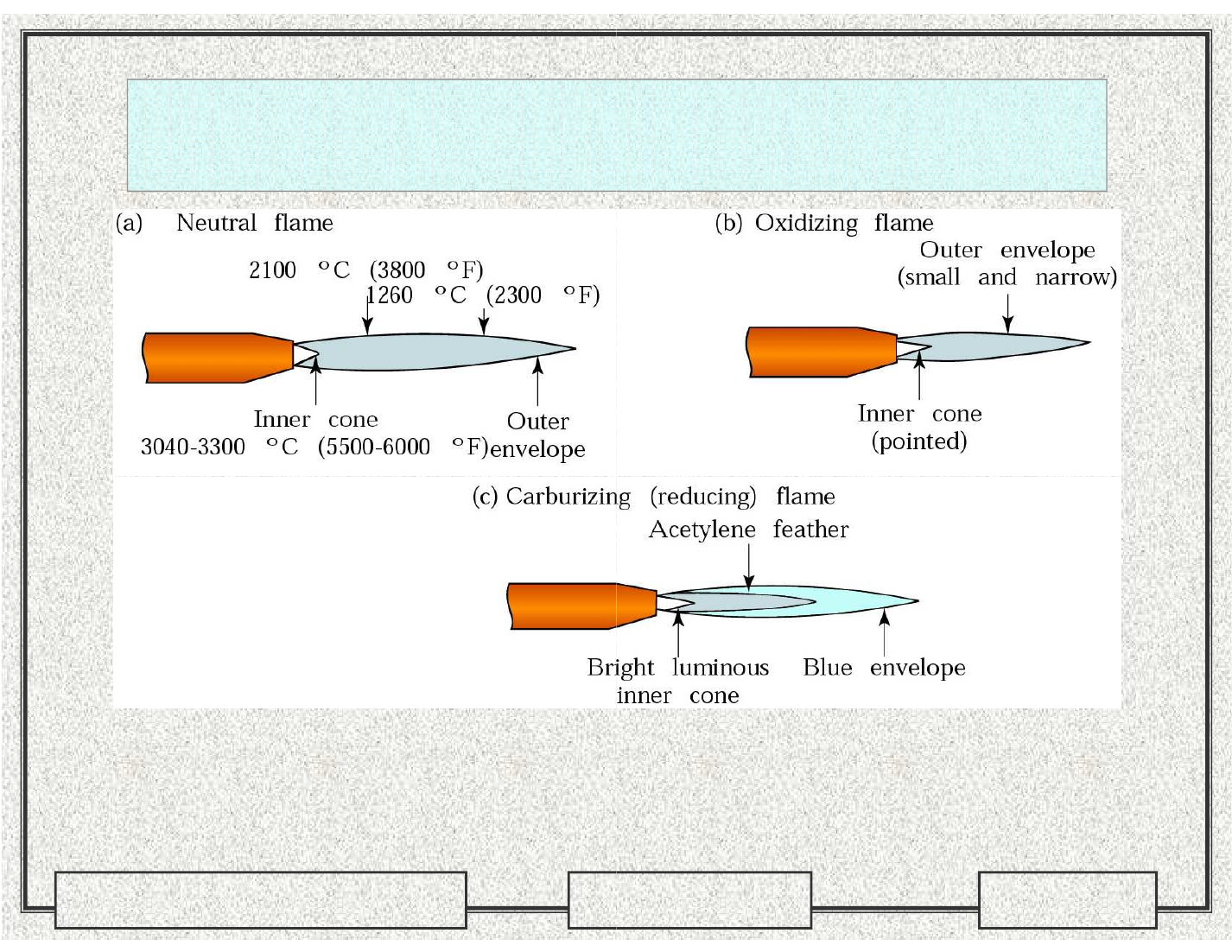
TYPES OF FLAMES
•         When acetylene is burned in air, it produces a yellow sooty flame, which is not enough for welding applications
•         Oxygen is turned on, flame immediately changes into a long white inner area (Feather) surrounded by a transparent blue envelope is called Carburizing flame (30000c)
•         This flames are used for hardening the surfaces
•         Addition of little more oxygen give a bright whitish cone surrounded by the transparent blue envelope is called Neutral flame (It has a balance of fuel gas and oxygen)
•         Most commonly used flame because it has temperature about 32000c
•         Used for welding steels, aluminium, copper and cast iron
•         If more oxygen is added, the cone becomes darker and more pointed, while the envelope becomes shorter and more fierce is called Oxidizing flame
•         Has the highest temperature about 34000c
•         Used for welding brass and brazing operation

 Advantages
  • Equipment has versatile
  • Same equipment can be used for oxy acetylene cutting and brazing by varying the torch size
  • Heat can controlled easily
Disadvantages
  • Slower process
  • Risk is involved in handling gas cylinders
GAS CUTTING
•         Ferrous metal is heated in to red hot condition and a jet of pure oxygen is projected onto the surface, which rapidly oxidizes
•         Oxides having lower melting point than the metal, melt and are blown away by the force of the jet, to make a cut
•         Fast and efficient method of cutting steel to a high degree of accuracy
•         Torch is different from welding
•         Cutting torch has preheat orifice and one central orifice for oxygen jet
•         PIERCING and GOUGING are two important operations
•         Piercing, used to cut a hole at the centre of the plate or away from the edge of the plate
•         Gouging, to cut a groove into the steel surface


Weld joint

There are 5 basic joint types in welding
•         Butt joint: Two materials are in the same plane, joined from the edges.
•         Corner joint:The corners of two materials form a right angle and joined.
•         Lap joint: Two parts overlaps.
•         Tee joint: One part is perpendicular to the other, making a T shape.
•         Edge joint: Edges of the two materials joined.


 Types of weld

  1. Fillet weld: Used in T joints,corner joints, lap joints.
  2. Groove weld:Used in butt joints.
  3. Plug weld: Used in lap joints.
  4. Slot weld: Used in lap joints.
  5. Spot weld: Used in lap joints.
  6. Seam weld: Used in lap joints.
  7. Flange weld:Used in edge joints.
  8. Surfacing weld:Not a joining process, it is used to increase the thickness of the plate, or provide a protective coating on the surface


Weldability is the ease of a material or a combination of materials to be welded under fabrication conditions into a specific, suitably designed structure, and to perform satisfactorily in the intended service


Brazing and Soldering

Brazing

It is a low temperature joining process. It is performed at temperatures above 840º F and it generally affords strengths comparable to those of the metal which it joins.  It is low temperature in that it is done below the melting point of the base metal.  It is achieved by diffusion without fusion (melting) of the base


          Depending upon the method of heating, brazing can be classified as

1.      Torch brazing
2.      Dip brazing
3.      Furnace brazing
4.      Induction brazing

            Advantages
Ø  Dissimilar metals which canot be welded can be joined by brazing
Ø  Very thin metals can be joined
Ø  Metals with different thickness can be joined easily
Ø  In brazing thermal stresses are not produced in the work piece. Hence there is no distortion
Ø  Using this process, carbides tips are brazed on the steel tool holders
            Disadvantages
Ø  Brazed joints have lesser strength compared to welding
Ø  Joint preparation cost is more
Ø  Can be used for thin sheet metal sections

Soldering
                 It   is a low temperature joining process. It is performed at temperatures below 840ºF for joining. 
Soldering is used for,
•         Sealing, as in automotive radiators or tin cans
•         Electrical Connections
•         Joining thermally sensitive components
•         Joining dissimilar metals